What is the best phone for running AI locally?
Buy for RAM first. In October 2026, 12GB phones such as the Pixel 11 and, per MacRumors, the iPhone Air run small models comfortably and 8-9B models with care. The 8GB Pixel 10a and iPhone 17e top out around 4B. The cheapest 16GB Apple, Google or Samsung phone is the $1,219 Pixel 11 Pro 512GB (Google Store, October 28).
This guide follows one buyer: someone replacing a three-year-old phone with $500 to $1,000 to spend, who wants an offline chat app such as PocketPal or Google AI Edge Gallery for drafting emails and summarizing notes on flights, and who is unsure whether 8GB of RAM is enough. Our guide to running AI on your phone offline covers the apps; this page is about the hardware.
Choose an 8GB phone if:
- Your budget tops out around $700, and small models of 1 to 4 billion parameters are enough for rewriting, short summaries and quick questions.
- You mostly want built-in features: Apple Intelligence runs on the iPhone 17e and iPhone 17, both 8GB phones according to MacRumors.
Choose 12GB if:
- You want Gemma 4 E4B in Google AI Edge Gallery, which lists 12GB as its minimum device memory.
- You want to try 8-9B models such as Qwen3.5 9B, a 5.68GB download at 4-bit.
- You want Apple's newest on-device dictation model, which Apple limits to its top iPhones: the Air, 17 Pro, 18 Pro and Duo.
Choose 16GB if:
- You want 9B models with room for longer chats, or to try 12B models such as Gemma 4 12B, a 7.12GB file at 4-bit.
- You plan to keep the phone for years and want headroom for whatever models come next.
How much RAM do you need to run AI on a phone?
A language model's weights, the billions of numbers it learned in training, must sit in RAM while it answers. Phone apps use quantized models, which store each weight in about 4 bits instead of 16 to shrink the file. Our rule of thumb is 0.55 to 0.65GB per billion parameters at 4-bit: Qwen3.5 9B is 5.68GB as a Q4_K_M GGUF file, and Gemma 4 12B is 7.12GB. GGUF is the quantized model format of llama.cpp, the engine inside PocketPal.
Gemma 4's phone models are larger than their names suggest. The E in E4B stands for effective parameters: 4.5B effective, 8B with embeddings, so its 4-bit GGUF is 4.98GB.
The model never gets all of the RAM. Android and your other apps keep running, and PocketPal's device rules tell it to leave about 25-35% of physical RAM as headroom so Android's low-memory killer does not close the app. On iPhone, each app has a default memory limit, and Apple says a higher limit is only available on some device models. Then there is context, the text the model keeps in view, and a longer context increases the amount of memory required.
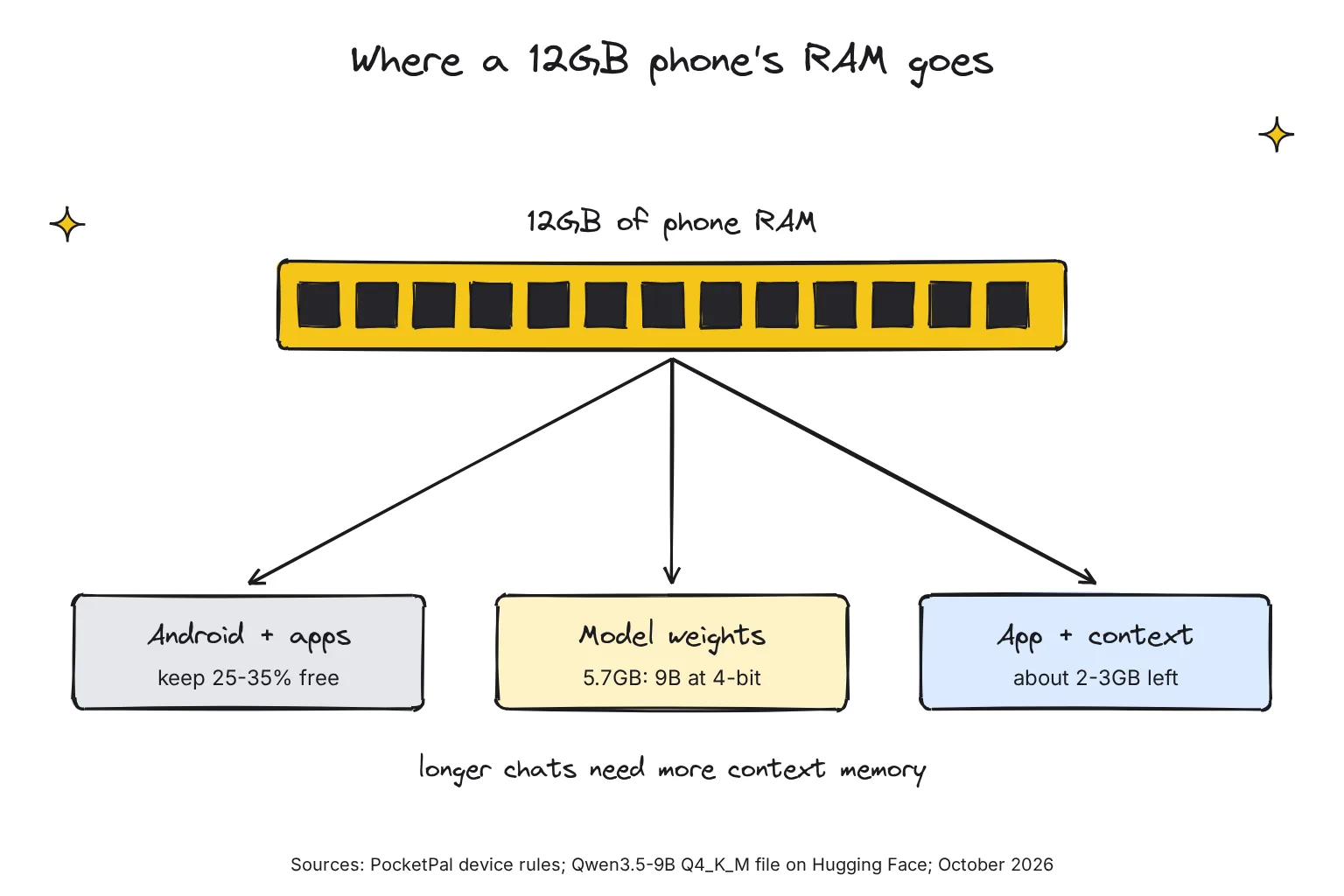
Here is the arithmetic for a 12GB phone running Qwen3.5 9B. Keeping 25-35% free leaves 7.8 to 9GB; the model takes 5.68GB, so about 2 to 3GB remains for the app and the context. That is workable for short chats and tight for long documents.
What can an 8GB phone run?
Models up to about 4B parameters. Qwen3.5 4B is a 2.74GB file at Q4_K_M, and Google's Gallery app lists Gemma 4 E2B, a 2.59GB download with an 8GB minimum. PocketPal's rules exclude Qwen3.5 9B Q4_K_M on 8GiB phones. For the reader's drafting and note summaries, a 4B model is usable; I would double-check its facts.
What can a 12GB phone run?
Everything above plus Gemma 4 E4B, which Gallery offers as a 3.66GB file for phones with at least 12GB, and 8-9B GGUF models such as Qwen3.5 9B with a modest context. This is the tier I would buy for the reader, because it opens up 8-9B models rather than only the smallest ones.
Is 16GB of RAM worth it on a phone?
Only if you want 9B models with long chats, or 12B models. With 35% kept free, a 16GB phone leaves about 10.4GB, enough on paper for Gemma 4 12B's 7.12GB file plus context. Expect it to be slower than a 4B model, because generating each token is bounded by memory bandwidth and a bigger model has more weights to read. On the Pixel 11 Pro, 16GB costs $120 more than 12GB: $1,099 for 256GB with 12GB, $1,219 for 512GB with 16GB on the Google Store on October 28.
Does the chip matter for local AI, or just the RAM?
The chip comes second. Apple's machine learning team explains that the first token is compute-bound, while generating subsequent tokens is bounded by memory bandwidth, how fast the chip can read RAM. Apple says A20 Pro in the iPhone 18 Pro has 50 percent more memory bandwidth than A19 Pro, a maker claim with no GB/s figure. None of the Apple, Google or Samsung spec pages I checked list memory bandwidth at all.
Google's own LiteRT-LM figures show how close flagships are. Gemma 4 E2B decodes at 52.1 tokens per second on the Galaxy S26 Ultra's GPU and 56.5 on the iPhone 17 Pro's; Gemma 4 E4B drops to 22.1 and 25.1. Tokens are word pieces. The bigger model ran at less than half the speed on both phones, so model size moved speed far more than the phone did.
On Android, the chip brand matters for GGUF apps. PocketPal's GPU path uses OpenCL on Qualcomm Adreno, llama.cpp's OpenCL backend is verified on the Adreno GPUs in the Snapdragon 8 Gen 3, 8 Elite and 8 Elite Gen 5, and PocketPal's rules class every Google Tensor chip through Tensor G5 as mid-range, so an 8GB Pixel such as the 10a gets the app's mid-tier model list. Pixels lean on Google's own stack instead: Gallery and Gemini Nano. Our guide to local LLM apps on Android compares the apps.
Do you need a powerful NPU for offline AI apps?
No. An NPU, or neural processing unit, is a low-power chip block for AI math, usually rated in TOPS (trillions of operations per second). Makers advertise it: Samsung claims a 39% improvement in NPU performance for the S26 Ultra, Google says Tensor G6 packs 50% more TPU compute, and the iPhone 18 Pro has a Dual 16-core Neural Engine. That hardware mainly serves built-in features: Samsung says its NPU gain powers always-on Galaxy AI features.
Third-party chat apps mostly use the CPU and GPU:
- PocketPal runs on the CPU, the GPU (Metal on iOS, OpenCL on Adreno) and Qualcomm's Hexagon NPU. The NPU path is experimental and needs Snapdragon 8 Gen 2 or newer; the maker claims it reads prompts at 2,725 tokens per second, 6.5 times the CPU, with a 1.2B model on Snapdragon 8 Elite Gen 5.
- Google AI Edge Gallery 1.0.20 sets Gemma 4 E2B and E4B to run on the GPU or CPU. Its LiteRT engine supports NPUs from Google Tensor, Qualcomm, MediaTek and Samsung Exynos, but Google's LiteRT-LM table marks NPU support on Android, not iOS.
- Locally AI on iPhone is powered by MLX, Apple's framework, which runs operations on the CPU or GPU over shared memory.
So do not pay extra for TOPS. Our explainer on NPUs and AI PCs reaches the same conclusion for laptops: memory and graphics matter more for chatbots.
The best phones for local AI in October 2026
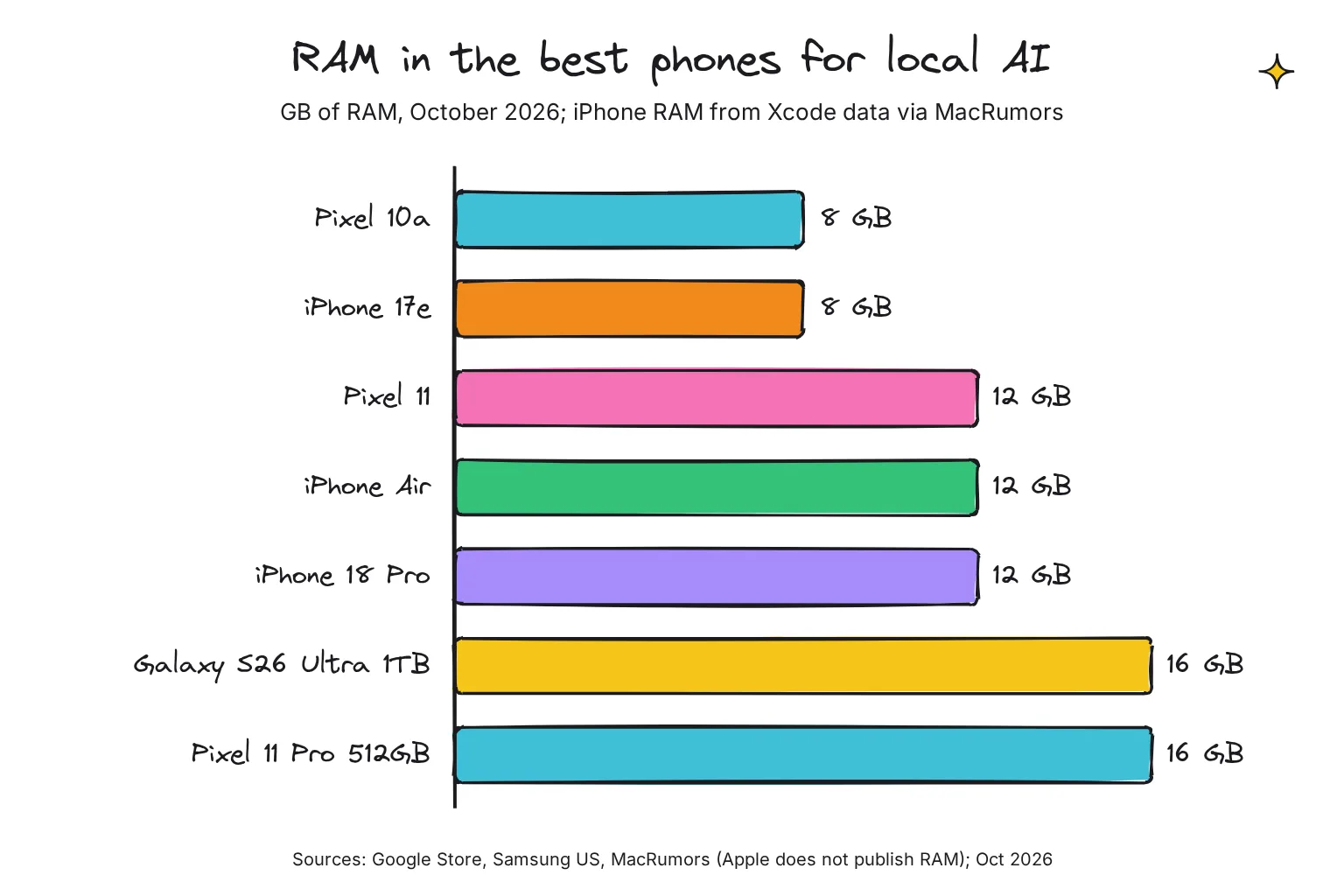
These are current models I verified on the makers' pages on October 28, 2026. Apple does not list RAM on its compare page or spec sheets, so iPhone RAM comes from MacRumors' readings of Apple's Xcode developer tool, published September 9, 2026 and March 5, 2026. Launch prices come from each maker's announcement; the last price column is what the maker's own US store listed on October 28, 2026, before trade-in.
| Phone | Chip | RAM | Storage | US launch price | Maker's store, Oct 28 | Suits |
|---|---|---|---|---|---|---|
| Pixel 10a | Tensor G4 | 8GB | 128GB, 256GB | $499 | $599 | Gallery with Gemma 4 E2B; 1-4B GGUF models |
| iPhone 17e | A19, 4-core GPU | 8GB (MacRumors) | 256GB, 512GB | $599 | $699 | Apple Intelligence; 1-4B models in Locally AI or PocketPal |
| Pixel 11 | Tensor G6 | 12GB | 256GB, 512GB | $899 | $899 | Gemma 4 E4B in Gallery; 9B models, short chats |
| Galaxy S26 | Snapdragon 8 Elite Gen 5 for Galaxy (US launch specs) | 12GB | 256GB, 512GB | $899.99 | $999.99, on sale at $849.99 | PocketPal GPU and NPU paths; 9B models, short chats |
| iPhone Air | A19 Pro, 5-core GPU | 12GB (MacRumors) | 256GB, 512GB, 1TB | $999 | $1,099 | Gemma 4 E4B; 9B models; Apple's top-tier on-device features |
| Pixel 11 Pro and Pro XL | Tensor G6 | 12GB (256GB), 16GB (512GB, 1TB) | 256GB, 512GB, 1TB | $1,099 and $1,299 | $1,099 and $1,299; 16GB Pro from $1,219 | 16GB models: 9B with long chats, 12B |
| Galaxy S26 Ultra | Snapdragon 8 Elite Gen 5 for Galaxy | 12GB (256GB, 512GB), 16GB (1TB) | 256GB, 512GB, 1TB | $1,299.99 | $1,399.99, on sale at $1,149.99 | PocketPal GPU and NPU paths; 9B models; 16GB at 1TB |
| iPhone 18 Pro and Pro Max | A20 Pro, 7-core GPU | 12GB (MacRumors) | 256GB to 2TB | $1,199 and $1,299 | $1,199 and $1,299 | Same models as the Air, with more memory bandwidth |
Prices have risen since launch: on October 28, Apple's store charged $100 more than at launch for the iPhone 17e, the iPhone 17 (launched at $799) and the iPhone Air, and Samsung.com listed the S26 Ultra 1TB, its only 16GB model, at $1,999.99 before a $1,749.99 sale price. Storage matters too: the model files above run from 2.6 to 7.1GB each, and Apple Intelligence's own models use approximately 7GB of space.
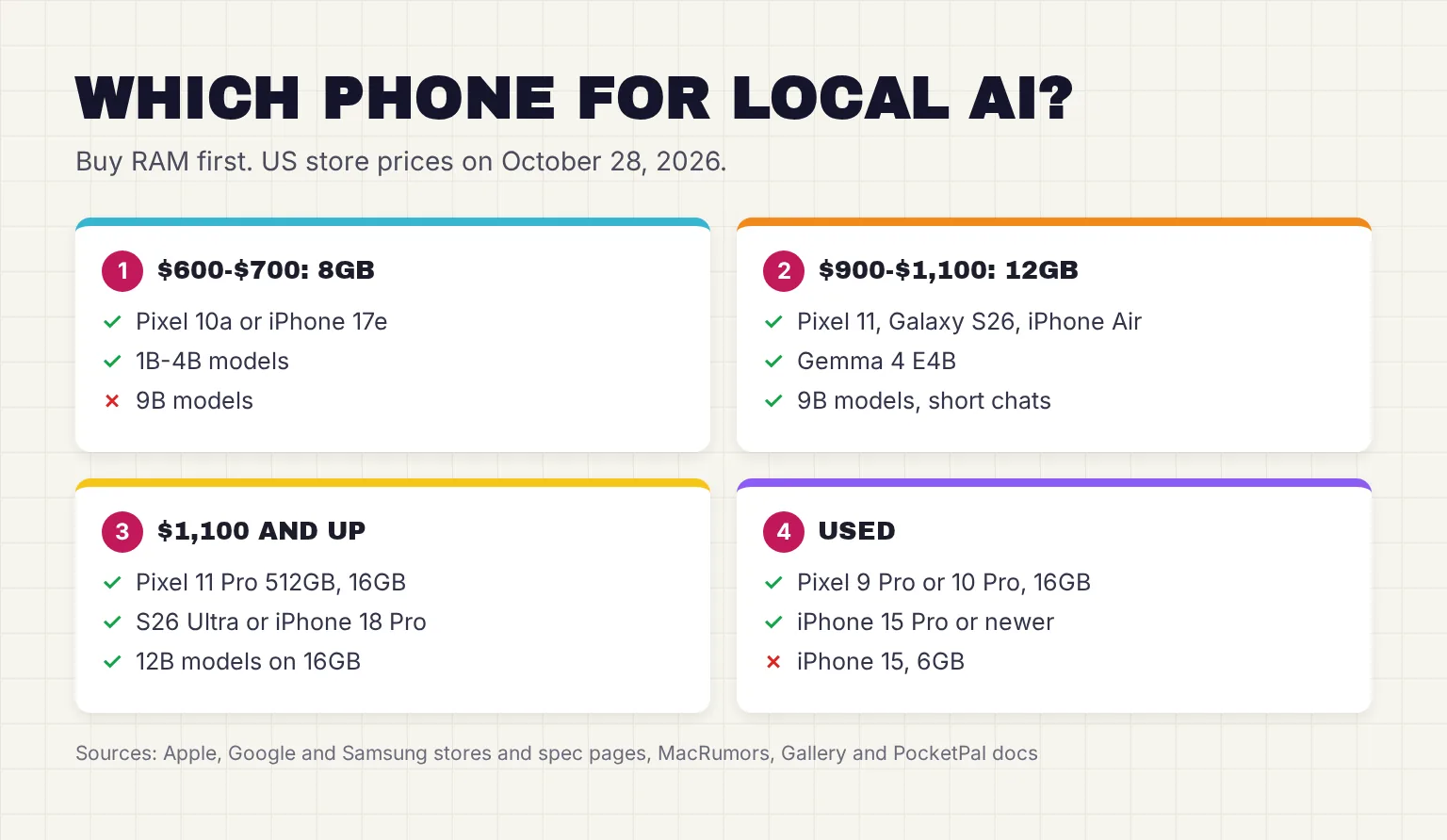
Best for $600 to $700: Pixel 10a or iPhone 17e
Both have 8GB, so both run 1-4B models. The Pixel 10a launched at $499 and listed at $599 on the Google Store on October 28; the 128GB base model leaves less room for model files. It suits Google AI Edge Gallery, though Gallery's code removes the GPU option on Pixel 10 phones, the 10a included, so Gemma 4 runs on its CPU.
The iPhone 17e launched with 256GB for $599 and listed at $699 at Apple on October 28, and it gets Apple Intelligence. Samsung's Galaxy S26 FE (Exynos 2500, launched at $699.99, the same on October 28) and Galaxy A57 5G (launched at $549.99, $599.99 on Samsung.com on October 28) also have 8GB, so they offer no RAM advantage for local AI.
Best for $900 to $1,100: Pixel 11, Galaxy S26 or iPhone Air
This is where the reader should land. The Pixel 11 has 12GB with Tensor G6 for $899, its launch price and still its Google Store price on October 28. The Galaxy S26 also has 12GB and launched at $899.99; Samsung.com listed it at $999.99 on October 28, on sale at $849.99. On Apple's store that day, the cheapest 12GB iPhone was the iPhone Air at $1,099, just over this budget, while the $899 iPhone 17 has 8GB like the cheaper 17e.
The S26's chip depends on where it is sold. Samsung's global specs list Snapdragon 8 Elite Gen 5 for Galaxy or Exynos 2600, varying by market, and its US launch specs list only the Snapdragon, the Ultra's chip. Samsung's US product page FAQ says Exynos 2600 instead, so if Snapdragon support matters to you, confirm the chip for the exact model before you pay.
Best for $1,100 and up: Pixel 11 Pro, Galaxy S26 Ultra or iPhone 18 Pro
Choose the Pixel 11 Pro 512GB if:
- You want 16GB for the least money: $1,219 on the Google Store on October 28, or $1,449 for 1TB.
- You use Google's Gallery and want the newest Gemini Nano (see the tie-breaker below).
Choose the Galaxy S26 Ultra if:
- You mainly use GGUF apps like PocketPal, whose GPU and NPU paths are Qualcomm-only; the Ultra runs Snapdragon 8 Elite Gen 5 for Galaxy.
- 12GB is enough, or you will pay for the 1TB model to get 16GB.
Choose the iPhone 18 Pro if:
- You want the fastest iPhone memory: same 12GB as the Air, with Apple's claimed 50% bandwidth gain.
- You also want its cameras; for local AI alone, the Air gives the same RAM for $100 less at Apple's October 28 prices.
The foldable iPhone Duo was announced at $1,999 in September, with the same A20 Pro; Xcode had not confirmed its RAM when MacRumors reported. Our guide to local LLM apps on iPhone covers what each iPhone runs in practice.
Apple Intelligence and Gemini Nano: the tie-breaker
Built-in AI uses the maker's own models, not the ones you download, but it can settle a close call. Our guide to what on-device AI means on phones explains what stays on the phone.
Which iPhones get the most on-device Apple Intelligence?
Apple Intelligence runs on every iPhone Apple sells, and on older models back to the iPhone 15 Pro. The top models get more: Apple's footnotes limit customizable Siri voices and a new on-device Dictation model to the iPhone 18 Pro, 18 Pro Max, Duo, 17 Pro, 17 Pro Max and Air. Those features come from AFM 3 Core Advanced, a 20-billion-parameter sparse model that Apple says is optimized for its most capable Apple silicon. Any app can also tap Apple's on-device models, and Apple says the features developers build work offline.
Which Android phones run Gemini Nano for apps?
Gemini Nano is Google's on-device model, and it runs in Android's AICore system service. Google's developer list puts the newest version, nano-v4, on the Pixel 11 series and Samsung's Z Fold8 and Z Flip8, with nano-v3 on the Galaxy S26 series and Pixel 9 and 10. The Pixel 10a, S26 FE and A57 are not on that list, though the 10a's spec sheet lists Gemini Nano for Google's own features.
Can an older or used phone run AI locally?
Yes, and a used flagship can have more RAM than a new mid-range phone. Google's Pixel tech specs page lists 16GB on every Pixel 9 Pro, 9 Pro XL, 10 Pro and 10 Pro XL, more than the base Pixel 11 Pro.
- Pixel: the Pixel 9, Pixel 10 and Pixel 8 Pro have 12GB; the Pixel 8, 8a and 9a have 8GB.
- Galaxy: the Galaxy S25, S25+ and S25 Ultra all have 12GB and Snapdragon 8 Elite for Galaxy. Samsung's Certified Re-Newed S26 Ultra arrived in September at $1,099.00, with a one-year warranty.
- iPhone: by MacRumors' reports, the iPhone 15 Pro and 15 Pro Max have 8GB, the iPhone 15 and 15 Plus 6GB, and the whole iPhone 16 line has 8GB. I would treat the 15 Pro as the floor, since the plain 15 also misses Apple Intelligence.
- Older Snapdragon phones: llama.cpp says A6x GPUs in phones are likely not supported, so phones with older Adreno 6xx graphics will likely run GGUF apps on the CPU.
Before you pay for any phone, new or used, run this check:
- Confirm the RAM for the exact storage size. Pixel 11 Pro and Galaxy S26 Ultra RAM changes with storage, so read the maker's spec page, not the listing title.
- Check the chip. On Android, Snapdragon gets PocketPal's GPU and NPU paths; Tensor phones rely more on Gallery.
- Leave storage free. Keep 10GB or more spare for two or three models.
- Test inside the return window. Install PocketPal or Google AI Edge Gallery, download the model you want, switch on airplane mode and chat for ten minutes.
Common questions about the best phone for local AI
How much RAM do I need to run AI on a phone?
For small 1B to 4B models, 8GB is the practical minimum. For 8B to 9B models or Gemma 4 E4B, buy 12GB, which Google AI Edge Gallery lists as the minimum for E4B. 16GB adds room for longer chats and 12B models. Keep 25 to 35 percent of RAM free for the system.
Is 8GB of RAM enough for local AI on a phone?
Yes, for small models. An 8GB phone such as the Pixel 10a, or the iPhone 17e by MacRumors' report, runs models up to about 4B parameters, such as Qwen3.5 4B or Gemma 4 E2B. PocketPal's rules exclude Qwen3.5 9B on 8GB phones, and Gallery needs 12GB for Gemma 4 E4B, so 8GB limits your choices.
Does the NPU matter for local LLM apps?
Less than the marketing suggests. Most third-party chat apps run on the CPU and GPU. PocketPal has an experimental NPU path on Snapdragon 8 Gen 2 and newer, while Google AI Edge Gallery runs Gemma 4 on the GPU or CPU. RAM decides which models you can load.
Is an iPhone or Android phone better for local AI?
Neither wins outright. Android offers 16GB phones, such as the Pixel 11 Pro 512GB, and Snapdragon models get the most acceleration in GGUF apps. Reported iPhone RAM tops out at 12GB, but iPhones run MLX apps well and get Apple Intelligence. Google's figures show similar speeds on an S26 Ultra and an iPhone 17 Pro.
How much RAM does the iPhone 18 Pro have?
The iPhone 18 Pro and 18 Pro Max have 12GB of RAM, the same as the iPhone 17 Pro and iPhone Air, according to MacRumors, which read the figure from Apple's Xcode developer tool in September 2026. Apple does not list RAM on its own spec pages.
Can a used phone run local AI models?
Yes. A used Pixel 9 Pro or Pixel 10 Pro has 16GB of RAM, more than a new base Pixel 11 Pro, and the Galaxy S25, S25+ and S25 Ultra have 12GB. On iPhone, the iPhone 15 Pro, reported to have 8GB, is a sensible floor. Check the exact model and storage size before you buy.
My verdict for a $500 to $1,000 buyer: get 12GB
For the reader in this guide, 12GB is the line that matters; the prices here are the makers' US store prices on October 28. On Android, buy the Pixel 11 at $899 if you like Google's Gallery app and Gemini Nano; pick a US Galaxy S26 ($999.99, often on sale) if PocketPal's Snapdragon acceleration matters more. On iPhone, stretch to the iPhone Air at $1,099 rather than the $899 iPhone 17, which has the same 8GB as the cheaper 17e. Drop to 8GB only if the budget is fixed at about $700, and pay for 16GB only if you know you want 9B-12B models.
Your next step: on the phone you have now, install PocketPal or Gallery, load a 4B model such as Qwen3.5 4B or Gemma 4 E2B, and try your real tasks offline. If the answers are good enough, an 8GB phone will do; if not, buy 12GB.
Sources
- Google Pixel 11 Specs: Details, Camera, & Security - Google Store
- Google Pixel 11 Pro & 11 Pro XL Technical Specs & Features - Google Store
- Explore the Pixel 10a Specs - Google Store
- Buy Google Pixel 11 Pro - Google Store
- Buy Google Pixel 10a - Google Store
- Buy Google Pixel 11 - Google Store
- Google introduces Pixel 11, Pixel 11 Pro and Pixel 11 Pro XL - Google
- Google announces the new Pixel 10a for $499 - Google
- Pixel phone hardware tech specs - Pixel Phone Help, Google
- iPhone - Compare Models - Apple
- iPhone 17e - Technical Specifications - Apple
- iPhone 17 - Technical Specifications - Apple
- iPhone Air - Technical Specifications - Apple
- iPhone 18 Pro and 18 Pro Max - Technical Specifications - Apple
- Buy iPhone 17e - Apple Store
- Buy iPhone 17 - Apple Store
- Buy iPhone Air - Apple Store
- Buy iPhone 18 Pro and iPhone 18 Pro Max - Apple Store
- Apple introduces iPhone 17e - Apple Newsroom
- Apple debuts iPhone 17 - Apple Newsroom
- Introducing iPhone Air, a powerful new iPhone with a breakthrough design - Apple Newsroom
- Apple debuts iPhone 18 Pro and iPhone 18 Pro Max - Apple Newsroom
- Apple unveils iPhone Duo - Apple Newsroom
- Apple Intelligence and Siri - Apple
- Introducing the Third Generation of Apple's Foundation Models - Apple Machine Learning Research
- Exploring LLMs with MLX and the Neural Accelerators in the M5 GPU - Apple Machine Learning Research
- com.apple.developer.kernel.increased-memory-limit - Apple Developer Documentation
- Unified Memory - MLX documentation
- iPhone 18 Pro and iPhone 18 Pro Max: Here's How Much RAM Each Has - MacRumors
- iPhone 17e Has 8GB of RAM as Expected - MacRumors
- iPhone 17, Air, and iPhone 17 Pro: Here's How Much RAM in Each Model - MacRumors
- iPhone 15 Pro and iPhone 15 Pro Max Feature Increased 8GB of RAM - MacRumors
- Samsung Unveils Galaxy S26 Series: The Most Intuitive Galaxy AI Phone Yet - Samsung Newsroom US
- Samsung Unveils Galaxy S26 Series: The Most Intuitive Galaxy AI Phone Yet - Samsung Global Newsroom
- Samsung Galaxy S26 Ultra - Samsung US
- Galaxy S26 Ultra buy page - Samsung US
- Samsung Galaxy S26 & S26+ - Samsung US
- Galaxy S26, S26+ and S26 FE buy page - Samsung US
- Galaxy A57 5G buy page - Samsung US
- Samsung Galaxy S26 FE: Delivering the Latest Flagship Features, Focused on What Matters Most - Samsung Newsroom US
- Samsung Unveils Galaxy A57 5G and Galaxy A37 5G - Samsung Newsroom US
- Samsung Galaxy S25 Series Sets the Standard of AI Phone as a True AI companion - Samsung Newsroom US
- Samsung Galaxy S26 Series Added to Certified Re-Newed Lineup - Samsung Newsroom US
- Overview of the ML Kit GenAI APIs - Google for Developers
- Gemini Nano - Android Developers
- LiteRT-LM Overview - Google AI Edge
- NPU acceleration with LiteRT - Google AI Edge
- gemma-4-E2B-it-litert-lm model card - LiteRT Community (Google), Hugging Face
- gemma-4-E4B-it-litert-lm model card - LiteRT Community (Google), Hugging Face
- Model allowlist 1.0.20 - google-ai-edge/gallery, GitHub
- ModelAllowlist.kt - google-ai-edge/gallery, GitHub
- PocketPal AI README - a-ghorbani/pocketpal-ai, GitHub
- rules.android.v2.json - a-ghorbani/pocketpal-device-rules, GitHub
- PocketPal AI - PocketPal
- llama.cpp for OpenCL - ggml-org/llama.cpp, GitHub
- Locally AI - Locally AI
- Context length - Ollama
- Qwen3.5-9B-GGUF files - unsloth, Hugging Face
- Qwen3.5-4B-GGUF files - unsloth, Hugging Face
- gemma-4-12b-it-GGUF files - unsloth, Hugging Face
- gemma-4-E4B-it-GGUF files - unsloth, Hugging Face
- gemma-4-E4B-it model card - Google, Hugging Face