What people want from uncensored AI, and what to know first
Maya is a novelist halfway through a draft. Her mainstream chatbot refused to help with a scene in which a manipulative character gaslights his sister, then declined a question about what an overdose actually does to the body, which her plot needs. She closes the tab annoyed. Within a day, her feeds fill with ads for "no filter" assistants promising answers without lectures. She wonders whether uncensored AI is worth trying, and whether it is safe.
She is not alone in the first part. Researchers call the habit of declining harmless requests over-refusal. One 2026 study of defensive security work found Claude 3.5 Sonnet refused 19.5% of authorized tasks, against 10.2% for GPT-4o and 6.6% for Llama 3.3. Vendors of alternatives say writers and developers are switching over dark fiction and similar requests, though those vendors have a stake in the story.
Fewer refusals do not make answers better. A 2026 BMJ Open study of five mainstream chatbots found only two refusals across 250 health questions, yet about half the answers were problematic. Maya's overdose question is a good example: a confident wrong answer is worse than a refusal.
No reliable figure shows how fast interest in these tools is growing, so this guide makes no such claim. It covers what "uncensored" means technically, where the limits are, what people actually use these tools for, and the legal, safety and scam risks. It neither sells the idea nor scolds anyone for asking.
How a model gets guardrails, and how they come off
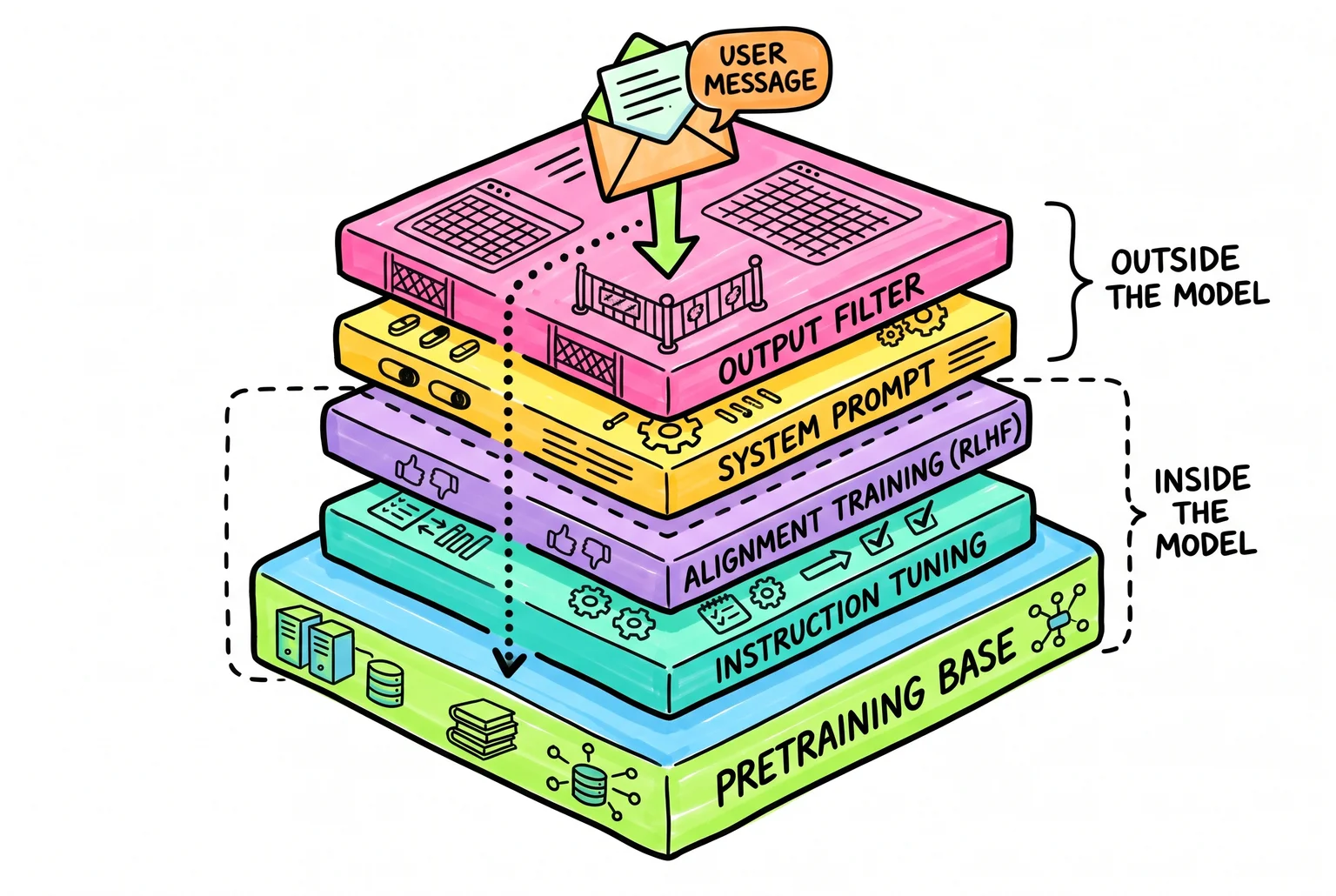
A mainstream chatbot's restraint comes from several layers, and "uncensored" can mean any of them was removed or never added.
The first layer is training. A model is pretrained on huge amounts of text, which teaches it language but not manners. Instruction tuning then teaches it to answer questions the way an assistant would. After that comes alignment training, where people rate responses and the model is pushed toward the ones they prefer. Meta says its Llama 3.1 instruct models use supervised fine-tuning and reinforcement learning with human feedback to match human preferences for safety and helpfulness. Anthropic's variant, Constitutional AI, has the model critique and revise its own answers against written principles, which reduces the need for human labelers.
Two layers sit outside the model. A system prompt is a hidden set of instructions the app prepends to every chat, and an output filter is a separate program that scans requests or answers and blocks some of them.
Models end up "uncensored" in four main ways. One is fine-tuning on different data. The Dolphin 2.9.1 Llama 3 70B model card calls the model uncensored and says its dataset was filtered to remove alignment and bias to increase compliance.
Another is abliteration. A 2024 paper by Arditi and colleagues found that refusal in chat models is concentrated in a single direction in the model's internal activations, meaning one consistent pattern in how the model represents a request. Across 13 open-source models of up to 72 billion parameters, removing that direction stopped refusals of harmful requests, and adding it made models refuse harmless ones. Community tools apply this by erasing the direction's influence from the weights themselves, so the change is permanent in the downloaded file.
Both methods depend on open-weight releases, where a developer publishes the trained model's weights for anyone to download and modify. Closed models like ChatGPT can't be edited this way.
The fourth is the jailbreak, a prompt written to talk a model past its rules. It changes nothing in the model and works only for that conversation, and providers patch against known ones. This guide doesn't reproduce any.
None of these is a clean off switch. The refusal finding concerns refusal behavior, and it doesn't show that every safeguard lives in one direction. Model cards for abliterated Llama 3 versions say so themselves: the 70B version warns it may still refuse or lecture on safety, and the 8B v2 says the same.
The word itself has no standard. Anthropic's constitutional classifiers research treats it as an ambiguous label that may describe model weights, app configuration, or service-level permissions. That produces a practical distinction. An uncensored model is a file with altered weights. An uncensored app is a service that may run an ordinary model with a loose system prompt and fewer filters, or an altered one, and the ad rarely says which.
What "uncensored" still won't do
Any claim of "no limits" is marketing. Restrictions exist at several levels, and removing the model's own refusals touches only one of them.
The model can still refuse. In one study of 20 modified models, average compliance on an unsafe-prompt set was 80%, so about one request in five went unfulfilled. The study doesn't say why each refusal happened, but research on model internals suggests refusal behavior can persist after safety-related edits, and the abliterated Llama 3 model cards quoted earlier warn about the same thing.
The service around the model adds its own rules. Hosted image and video generators apply content and likeness rules whatever the underlying model would allow. Apps distributed through Apple's store must meet its review guidelines, which can limit access independently of the weights. Even services that sell themselves on being uncensored publish terms. The acceptable-use policies of Uncensored AI and Uncensored AI Chat both prohibit sexual content involving minors, including fictional or AI-generated depictions.
The law sits above all of it. U.S. federal law covers certain depictions of minors, including specified computer-generated images. No settings change that.
Quality is a separate question. Fewer refusals don't make a model smarter, and most uncensored models are modified versions of smaller open-weight models that trail the best commercial systems. Evidence on whether the edits hurt accuracy is mixed. Some edits damage capabilities, but the evaluations don't show a universal accuracy or hallucination penalty. Judge each model on its own results.
Maya's two requests show the difference. An uncensored model will likely write her dark scene, since violence in fiction is within what most services allow. It may also answer the medical question more frankly. A frank answer can still be wrong, though, and a model without a refusal won't flag its own uncertainty. If she wanted the scene to include sexual content involving a minor, no legitimate service would produce it, and producing it could be a crime.
Dark fiction and character roleplay
Fiction is the use closest to Maya's situation. Novelists, fan-fiction writers and game masters want villains who sound like villains, abuse scenes that read as harrowing rather than sanitized, and moral choices without a lecture attached. Mainstream tools often balk at this. An uncensored model or a service built on one will usually write a violent or disturbing scene as fiction, and Maya's chapter would likely be in that category.
Roleplay is the larger and stranger use. In a February 2025 Redpoint/Centiment survey of more than 250 consumers, 56% had used an AI companion. Of those users, three in four chatted weekly and half spent over an hour a week doing it. The same report describes the activity as frequent social interaction and fictional or romantic roleplay, not only sexual content. Adult content is part of the picture, but no reliable figure says how big a part. The later section on adult content covers it directly.
The risks attach to specific, documented problems.
Minors. Italy's data-protection authority fined Replika's maker €5 million in 2025, finding that it lacked age verification despite claiming to exclude minors. In January 2026, Kentucky became the first state to sue Character.AI, alleging it exposed children to harmful content. California's SB 243 now requires covered chatbot operators to remind minors they are talking to an AI.
Dependence. In a four-week MIT Media Lab and OpenAI study of 981 people, those who chose to use the chatbot more showed more emotional dependence, more problematic use and more loneliness. Families have also sued Character.AI, alleging its bots fostered dependent relationships with teenagers, including in a 14-year-old's suicide.
Terms and data. Platform terms govern what you can write and who owns the output, and they change. Intimate chats are stored on someone's servers, so a company's privacy policy and retention rules decide who can read them later.
Red-teaming, security research and frank medical answers
Professionals reach for uncensored models for a practical reason: fewer refusals make it easier to study how a model fails. Researchers may use them to examine bias, malware-related reasoning, or sensitive medical and mental-health questions that a locked-down model would decline to engage with.
Red-teaming is the formal version. The Biden administration's Executive Order 14110 defines AI red teaming as structured adversarial testing, often in a controlled environment and with the developer's cooperation. NIST's ARIA approach adds human testers who react to model outputs, working from written scenarios, prompt sets and an annotation scheme. Plans start by defining the target, the realistic threats and how much access testers have, and they end with a blue-team step that turns findings into mitigations.
Security researchers use models to study phishing patterns and malware behavior. Attackers use them too. Google reported that more than 40 state-sponsored groups had used Gemini across the attack life cycle, with productivity gains rather than new offensive capabilities. A later Google report described malware such as PROMPTFLUX and PROMPTSTEAL that calls an LLM while running.
The line between analysis and operation is whether anything touches a real system or real people's data. Studying a sample in an isolated lab is research. Pointing a model's output at a network you don't own is not, whatever your motive. The US Computer Fraud and Abuse Act prohibits unauthorized access, and the UK's Computer Misuse Act works similarly, with prosecutors told that a research purpose doesn't make access lawful. A 2022 DOJ policy says good-faith security research should not be charged, but it is prosecutorial guidance, not a legal exemption. Researchers are advised to get written authorization, define scope and use isolated environments, and some still face legal threats over their reports.

Medical, drug-safety and mental-health questions are the use closest to ordinary readers. People want a direct answer about a dose, an interaction or a symptom without a paragraph of disclaimers. The hedging is irritating, but it exists because chatbots get health questions wrong. One report on a 2026 study found that chatbots gave misleading medical advice about half the time.
A frank answer is not a correct one. Uncensored fine-tunes tend to be smaller and less carefully tested than frontier models, and removing refusals does not add accuracy. A confident wrong dose reads exactly like a confident right one. For drug or mental-health questions, treat any chatbot as a starting point for a conversation with a pharmacist, a doctor or a crisis line, and verify anything that affects your body against a source with a named author.
How people access uncensored models, and what privacy they actually get
Maya's choice comes down to where the model runs. There are three routes: on her own computer, in a hosted web or mobile app, or through an API that developers call from their own software.
Running an open-weight model locally is the option that keeps prompts on the device. Tools like Ollama run models on a CPU and support GPU acceleration on compatible NVIDIA, AMD and Apple Silicon hardware. Memory needs vary with the model, quantization, context length and number of simultaneous requests. Ollama's quickstart suggests 8 GB of VRAM or Apple unified memory for a small model like Gemma 4 E2B, and larger models need far more. On modest hardware, expect slower replies and smaller, weaker models. Local inference removes the provider from the picture, but the machine, the app and the files you download still carry ordinary security risks.
Hosted apps trade that privacy for convenience. They run on someone else's servers, so speed and model size are better, and free tiers usually come with limits that paid plans lift. What happens to her prompts depends on the provider's policy. Brave's Leo, a mainstream example, states that it doesn't retain prompts or responses on its servers and doesn't train on conversations. Many apps sold as uncensored publish nothing comparable.
Uncensored status says nothing about privacy. In 2024, a Muah.AI breach exposed 1.9 million email addresses linked to user prompts, including sexual ones. In 2025, Cybernews found an unauthenticated server exposing over 43 million messages from two companion apps, covering more than 400,000 users. These came from misconfigured infrastructure, not attacks on the models.
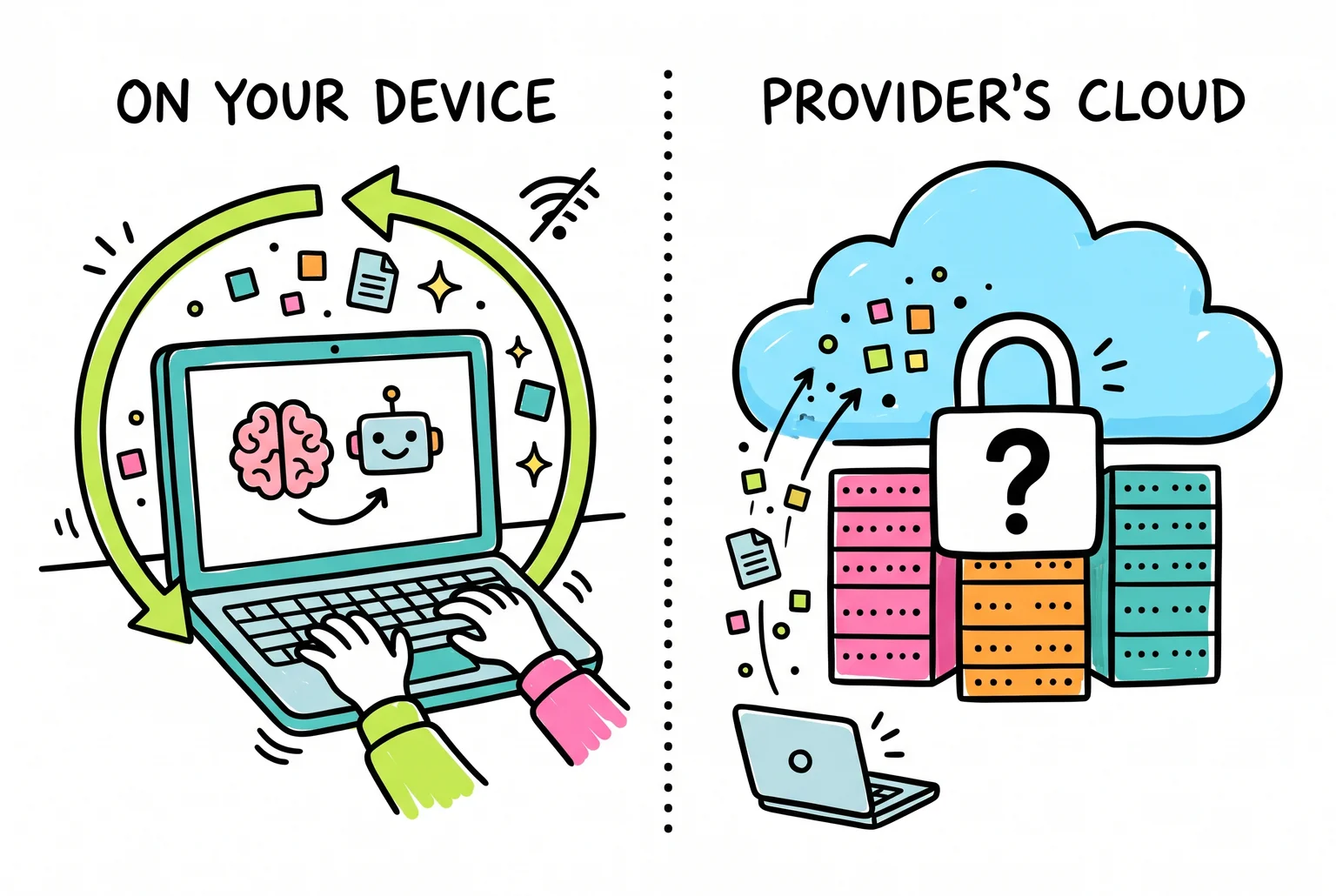
Image and video generation follows the same split. Open-weight image models can be fine-tuned to weaken or remove safety filters, so local tools have fewer limits. Hosted services add rules. Civitai bans content based on real people's likenesses and photorealistic minors, yet one analysis of a six-day window in August 2024 found deepfake requests persisted despite the ban.
For Maya, a local model suits sensitive manuscript material if her laptop can handle it. A hosted app is easier, provided she reads its retention policy first.
Legal exposure, fake apps and bad downloads
Using an uncensored model is legal in most places. What you generate with it is where the law applies, and the same rules cover mainstream and uncensored tools alike.
AI-generated child sexual abuse material is not a legal loophole. Generating, requesting, possessing or sharing it exposes you to prosecution, and the Congressional Research Service notes that the U.S. TAKE IT DOWN Act provides up to three years' imprisonment for certain publication involving minors, including digital forgeries. Non-consensual intimate deepfakes of real adults, defamatory fabrications about real people and AI-written fraud carry their own liability. Rules differ by country. The EU AI Act, as amended, prohibits non-consensual intimate AI content and CSAM, with compliance required by December 2, 2026, deepfake transparency duties from August 2, 2026, and fines for prohibited practices up to €35 million or 7% of worldwide turnover.
Fake apps are the more common danger for ordinary users. In May 2025, fake AI image and video tools promoted on Facebook spread the Noodlophile stealer, and one post drew more than 62,000 views. Counterfeit pages impersonating Kling AI could have reached over 22 million people with a remote-access Trojan. Malwarebytes documented a wave of fake ChatGPT and AI-app clones, some carrying spyware behind spoofed certificates and obfuscated code.
Paid "criminal AI" is a scam market of its own. Trustwave documented FraudGPT as a subscription service at $90 to $200 a month. Rapid7 reports that current WormGPT variants are wrappers around commercial models using system prompts, and advises against paying anonymous sellers for "uncensored" access.
Model repositories carry risk too. JFrog found about 100 suspicious Hugging Face models, one of which used a malicious Python pickle payload to open a reverse shell and give an attacker control of the victim's machine. Data leaks, covered in the previous section, add to this picture.
A defensive checklist
- Get software from the developer's verified domain or an official app store, and check that the developer name matches the one you expected.
- Read recent reviews for reports of charges, crashes or permission demands.
- Avoid sideloaded installers, especially any that ask for administrator rights.
- Treat requests to disable security software or reveal private keys as a stop sign.
- Prefer safetensors files for local models. A safer format does not vouch for the repository, its custom code or its dependencies.
- Read the billing terms and cancellation process before entering a card, and use a card with a spending limit.
- Skip any seller who markets a name like WormGPT as proof of capability.
How to decide if you need it
"Uncensored" is a marketing label for models or apps with fewer refusals, reached through fine-tuning, abliteration, open weights or a wrapper around a jailbreak. No version is fully unrestricted. Hosts, app stores, payment processors and the law still set limits, and fewer refusals often come with weaker accuracy.
Start with what actually blocked you. If the refusals were mild, a clearer prompt or a different mainstream tool will often do. Anthropic's usage policy does not categorically prohibit fiction, and mainstream tools may allow some mature creative writing in the right context. They keep firm limits on sexual content involving minors, exploitation and real-world harm. Age verification does not guarantee adult content either.
Consider uncensored tools when the refusals are persistent and your purpose is lawful: fiction with dark themes, authorized security work, research, or privacy through a local model. Weigh that against unreliable output, fake apps, leaked chats and legal exposure for what you generate.
Maya's case fits the first group. A dark scene is ordinary fiction, and her medical question is better answered by a clinician or a reputable source, since a model with fewer refusals is no more accurate. She should rewrite her prompt, try another mainstream assistant, and consider a local model only if she still hits walls.
How adult pictures and sexual roleplay work, and where the lines are
People get adult content from AI in two ways: companion and roleplay chat services that allow sexual conversation, and image generators that produce explicit pictures from text prompts. Both run either as hosted web or mobile services or as open models on a person's own computer, which the privacy section covered. The hosted route is where most users end up, and the numbers are large but loose. AI girlfriend apps reportedly served more than 100 million users in 2025, and a 2025 survey found that 19% of U.S. adults had interacted with an AI romantic partner, including 31% of men aged 18 to 30. Candy AI drew an estimated 33 million monthly visits by April 2026. These figures come from third-party trackers and marketing sites that count visits, accounts and sessions differently, so treat them as rough scale rather than precise counts.
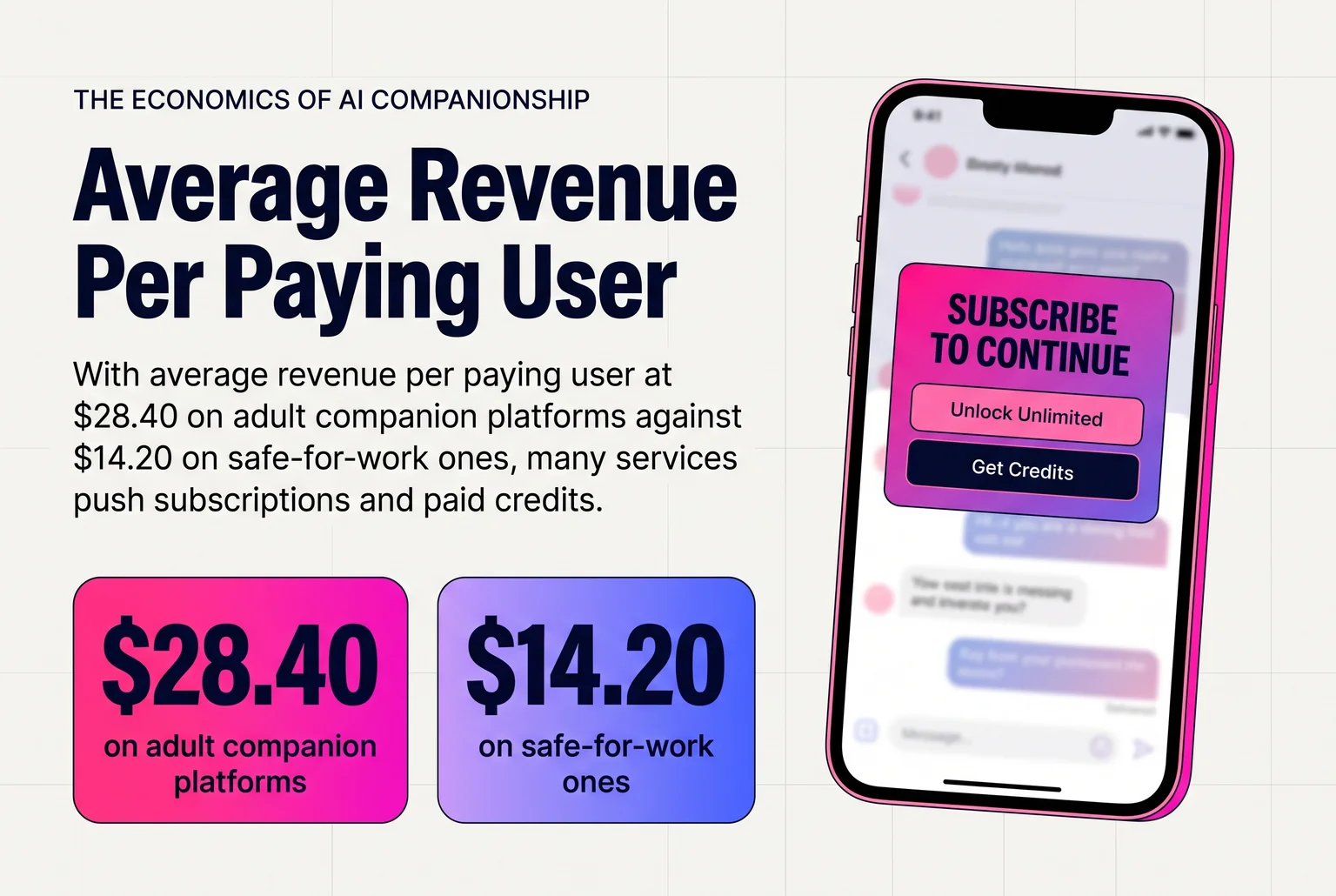
Adult content pays better than the rest of the category. One industry report put average revenue per paying user at $28.40 on adult companion platforms against $14.20 on safe-for-work ones, which explains why so many services push subscriptions and paid credits.
Consent is the sharpest legal line. Generating explicit images of a real person without their agreement is the core harm behind "nudify" apps. A 2026 investigation found 55 such apps on Google Play and 47 on Apple's App Store, with an estimated 705 million downloads and $117 million in lifetime revenue. Google deleted all five Android apps flagged to it, and Apple removed three of eight. In July 2026 San Francisco's city attorney sent cease-and-desist letters over 13 apps, citing a California law with civil penalties starting at $25,000 per violation.
The federal TAKE IT DOWN Act, signed in May 2025, requires covered platforms to remove non-consensual intimate images within 48 hours of a notice. Fictional characters and adults who consent fall outside that concern, but anything built from a real person's photo does not. The same data risks apply here as elsewhere: intimate chats and uploaded images sit on someone's server.
Related guides
- Private AI options ranked: from chatbot privacy settings and business plans to running models on your own laptop.
- Can you run ChatGPT locally?: set up gpt-oss-20b with Ollama on a 16GB PC or Mac, and see which models fit your memory.
- Local AI vs cloud AI: real token speeds, hardware and running costs, and where local models fall behind.
- Make AI images on your own computer: what your computer needs, which free app to start with and how to make your first picture.
Sources
- Beyond No: Quantifying AI Over-Refusal and Emotional Attachment Boundaries - PeopleTec, Inc.
- Why AI Refuses Hacking Requests (And the Real Fix in | XHack - XHack
- Why Writers and Developers Are Switching to Unrestricted AI in 2026 - Uncensored Chat
- AI chatbots give misleading medical advice 50% of the time, study finds - The Japan Times
- llama-models/models/llama3_1/MODEL_CARD.md at 0e0b8c519242d5833d8c11bffc1232b77ad7f301 · meta-llama/llama-models · GitHub - Meta
- Constitutional AI: Harmlessness from AI feedback \ Anthropic - Anthropic
- huggingface.co - Hugging Face
- Refusal in Language Models Is Mediated by a Single Direction - arXiv
- Comprehensive Research Survey: LLM Refusal Removal, Abliteration, and Mechanistic Interpretability of Safety Mechanisms - Hugging Face
- nguyenthilaitrieulong/llama-3-70B-Instruct-abliterated · Hugging Face - Hugging Face
- QuixiAI/Llama-3-8B-Instruct-abliterated-v2 · Hugging Face - Hugging Face
- Constitutional Classifiers \ Anthropic - Anthropic
- Study of modified models’ compliance on an unsafe-prompt set - MDPI
- Usage Policy - Runway
- App Store Review Guidelines - Apple Developer
- Acceptable Use Policy - Uncensored AI
- Acceptable Use Policy - Uncensored AI Chat
- Citizen’s Guide to U.S. Federal Law on Child Pornography - U.S. Department of Justice
- Auditing Abliteration: Normalization, Placement, Edit Budget - University of Miami
- Redpoint Radar: Consumer’s Situationship with Computer-Generated Companions | Redpoint Ventures - Redpoint Ventures
- Redpoint Radar: Consumer’s Situationship with Computer-Generated Companions | Redpoint Ventures - Redpoint Ventures
- AI: The Italian Data Protection Authority fines company behind chatbot “Replika” - Garante per la protezione dei dati personali
- AG Coleman Sues AI Chatbot Company for Preying on Children - Office of the Kentucky Attorney General
- Kentucky Enforcement Action Against Character.AI - Kilpatrick Townsend & Stockton LLP
- How AI and Human Behaviors Shape Psychosocial Effects of Extended Chatbot Use: A Longitudinal Controlled Study - MIT Media Lab
- Attorney General James Urges Court to Protect Children and Consumers in Character.AI Bankruptcy - Office of the New York Attorney General
- Early lessons from evaluating frontier AI systems - AI Safety Institute (AISI)
- Supporting NIST's Development of Guidelines on Red-teaming for Generative AI - Carnegie Mellon University (Block Center and K&L Gates Initiative)
- ARIA Evaluation Planning Manual: Elements of ARIA-Style AI Evaluations - NIST
- Google reveals Gemini AI use by more than 40 state-sponsored APTs - SC Media
- Google warns of AI misuse in new GTIG threat report - SecurityBrief Australia
- A "Grey Hat" Guide | Electronic Frontier Foundation - Electronic Frontier Foundation
- Computer Misuse Act | The Crown Prosecution Service - Crown Prosecution Service
- Office of Public Affairs | Department of Justice Announces New Policy for Charging Cases under the Computer Fraud and Abuse Act - U.S. Department of Justice
- Coders' Rights Project - Electronic Frontier Foundation
- Ollama GPU support - Ollama
- Ollama Quickstart - Ollama
- Browser Privacy Policy | Brave - Brave Software, Inc.
- AI Girlfriend Data Breaches: A Running Tracker | Local Waifu - Local Waifu
- AI girlfriend data breach: 400K+ users affected | Cybernews - Cybernews
- Erasing Concepts from Diffusion Models - ICCV
- Content Rules: Real People | Civitai - Civitai
- A Marketplace for AI-Generated Adult Content and Deepfakes - arXiv - arXiv
- The TAKE IT DOWN Act - Congressional Research Service
- High-risk AI in the European Union - AI Laws of the World - DLA Piper
- Fake AI Tools Used to Spread Noodlophile Malware, Targeting 62,000+ via Facebook Lures - The Hacker News
- Attack of the clones: Fake ChatGPT apps are everywhere - Malwarebytes
- What is hackbot as a service and are malicious LLMs a risk? | IT Pro - IT Pro
- Criminal AI-as-a-Service in 2026: How the Underground Market Is Operationalizing Cybercrime - Rapid7
- Examining Malicious Hugging Face ML Models with Silent Backdoor - JFrog
- PDF version of 2026 Usage Policy - Google Docs - Anthropic - Anthropic
- AI Girlfriend Statistics 2026: Market Size, User Data & Platform Insights - AIGirlfriends.ai
- AI Porn Generation Statistics: Market Size and Growth Rates - OhGirlfriend
- AI Girlfriend Industry Report | Monthly Data Index 2025 - 2026 - AIGirlfriends.ai
- San Francisco Demands Apple and Google Delete AI 'Nudify' Apps From Their Stores - Gadget Review
- Explicit Images | WashU Law - WashU Law